Inside the Virtual Dressing Room Revolution
Explore how the virtual dressing room uses AI and AR to transform online shopping. Learn how it works, why it's a game-changer, and see real-world examples.
Picture this: trying on a dozen outfits from your favorite brand without ever leaving your living room. This isn't some far-off sci-fi concept—it's the reality of the virtual dressing room, a technology that's completely changing how we shop online. It’s the closest we’ve come to solving e-commerce’s biggest headache: how will this actually look and fit on me?
The Future of Shopping Is Now
That leap from a static product page to seeing a garment on your own body is a quantum leap for customer confidence. A virtual dressing room uses a sophisticated combination of Augmented Reality (AR) and Artificial Intelligence (AI) to digitally drape clothing onto your image, finally putting an end to the frustrating guesswork of online sizing charts.
This technology is rapidly transitioning from a novelty to a strategic imperative for modern retailers. It directly confronts the primary barrier in online apparel shopping—the inability to physically try an item before purchase. According to Radosław Szeja, Retail Consulting Director at Netguru, "The number one challenge for online shoppers is a lack of fitting room experience."
A Market on the Rise
The explosive growth of this technology signals a seismic shift in consumer behavior and retail strategy. The global virtual dressing room market is expanding at a breakneck pace, underscoring its pivotal role in the future of commerce.
According to a comprehensive analysis by Astute Analytica, the market was valued at USD 6.09 billion in 2023 and is projected to skyrocket to USD 32.29 billion by 2033. This reflects a compound annual growth rate (CAGR) of 18.3%, indicating robust and sustained market demand.
Bridging the Digital and Physical Worlds
Ultimately, a virtual dressing room accomplishes more than just displaying an outfit. It constructs a critical bridge between the convenience of digital commerce and the confidence derived from an in-store try-on.
It is an essential component in creating a seamless omnichannel customer experience, enabling shoppers to transition fluidly between a brand's digital platforms and its physical locations. By allowing consumers to visualize products in a personalized and interactive manner, this technology is establishing a new benchmark for online apparel retail.
How Virtual Dressing Rooms Actually Work
Ever wondered what digital alchemy allows you to try on a sweater through your smartphone screen? Let's dissect the technology. At its core, a virtual dressing room is a brilliant synergy of two powerful technologies working in concert to create a seamless, digital "try before you buy" experience.
The user-facing component is Augmented Reality (AR). This technology functions as a digital mirror, overlaying a virtual image of a garment onto a live video feed from a phone or webcam. Consider it a highly intelligent, interactive filter engineered specifically for fashion.
However, the true intelligence—the brains of the operation—stems from Artificial Intelligence (AI) and its subfield, Machine Learning (ML).
The Power of AI and Data
AI algorithms are the engine of personalization. They analyze the video feed or an uploaded photograph, instantly identifying key bodily landmarks to estimate measurements. This enables the system to predict how a specific garment will drape, stretch, and conform to an individual's unique physique. It represents a monumental upgrade from generic size charts that fail to capture the nuances of body shape.
The most advanced platforms elevate this further, generating a personalized 3D digital avatar of the user's body. This creates a hyper-realistic simulation of how fabric will fold, cling, and move, allowing the virtual dressing room to confidently recommend the correct size.
The entire process is engineered for user simplicity, as this flow demonstrates.
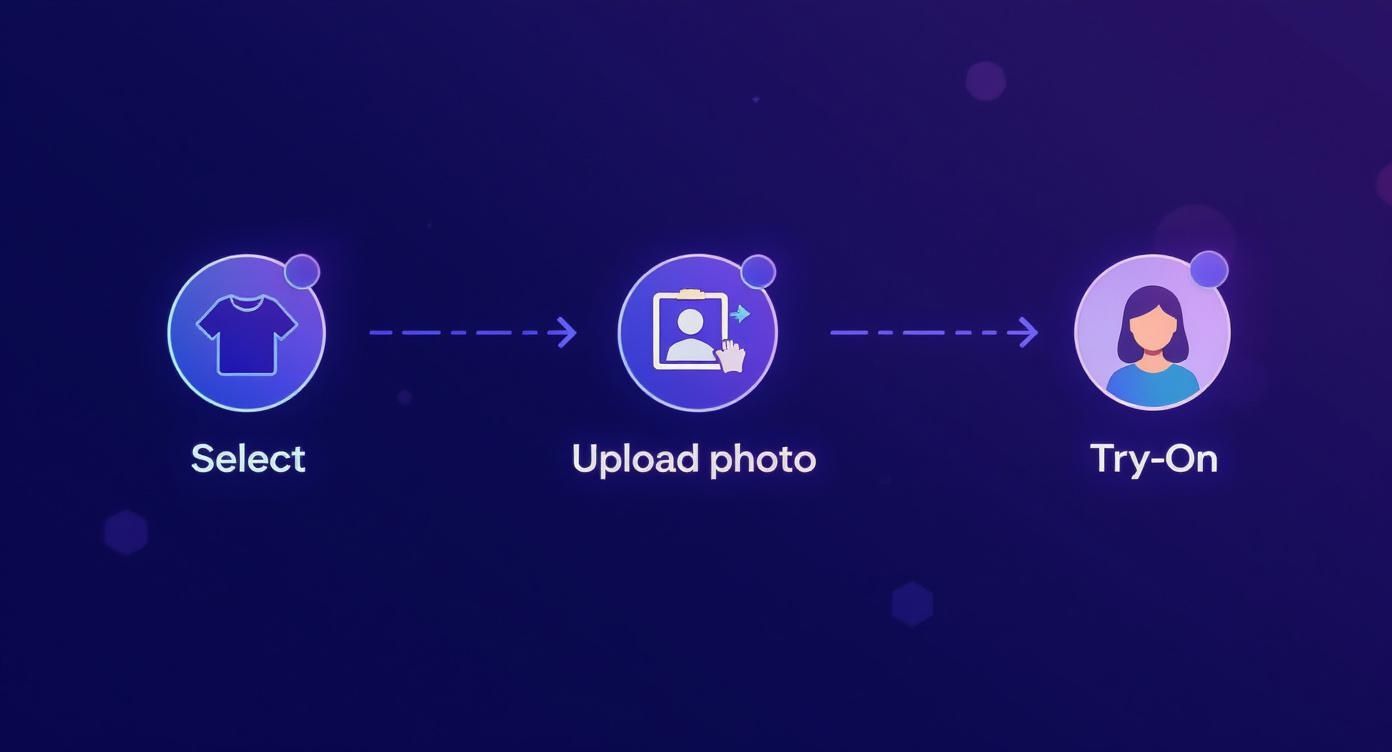
This simple three-step journey—select an item, provide a photo, and view the result—is what makes profoundly complex technology feel entirely effortless.
From Simple Overlays to Realistic Simulation
It is critical to understand that not all virtual try-on tools are created equal. The technology ranges from basic 2D overlays (placing a flat image onto a photo) to highly sophisticated 3D fittings that meticulously mimic a real-world try-on. The objective of premier systems is to achieve the highest possible fidelity to reality.
As Lilian Rincon, a Senior Director of Product at Google, emphasizes, the goal is to help shoppers visualize how new styles will appear on them, not a model.
"Our virtual try-on technology... helps shoppers see a diverse selection of models that look like them, in a range of sizes. Now, you can see how clothing looks on a selection of 80 models in sizes XXS through 4XL, representing different skin tones, body shapes, and hair types."
This definitive shift toward authentic personalization is paramount. Using relatable models or one's own photo makes the preview more accurate and, crucially, more trustworthy. You can explore how these components converge in a modern virtual try on clothes app.
Ultimately, this potent blend of AR and AI provides the necessary confidence to click "add to cart" from the comfort of home.
Why Retailers Are Betting Big on Virtual Try-Ons
Why are major brands strategically investing in virtual dressing room technology? The answer is unequivocal: it is not a mere gimmick but a powerful business tool that delivers tangible, measurable results impacting the bottom line. It serves as the ultimate solution to some of the most persistent and costly challenges in e-commerce.
For any online retailer, the most significant drain on profitability is product returns. Returns are a logistical and financial nightmare, incurring costs for reverse shipping, restocking, and often resulting in merchandise that must be sold at a discount. A 2023 survey by the National Retail Federation (NRF) revealed that for every $1 billion in sales, the average retailer incurs $165 million in merchandise returns.
This is where virtual try-on technology completely rewrites the financial equation. By providing a shopper with a highly realistic preview of how an item will fit and look on their specific body, it builds the confidence required to purchase and drastically reduces the likelihood of a return.
More Conversions, Fewer Returns—The Holy Grail of E-Commerce
When a customer feels certain about their selection, they are significantly more likely to complete the purchase. A virtual dressing room addresses the primary source of hesitation in online fashion—the persistent "what if it doesn't fit?" doubt—thereby directly boosting conversion rates.
The impact is profound. Shopify reports that interactions with 3D content, including virtual try-ons, can increase conversion rates by up to 250%. Simultaneously, retailers have seen return rates plummet. According to research from Coresight, 40% of consumers stated they would be more likely to shop with a retailer offering AR virtual try-on. You can dive deeper into the numbers in this report on the virtual dressing room market.
As Carolina Arguelles, a product marketing lead at Snap Inc., stated, "AR is a utility. It solves real business challenges, one of the biggest being returns."
The table below breaks down just how transformative this technology can be.
Impact of Virtual Dressing Rooms on E-Commerce Metrics
This isn't just about marginal improvements; we are witnessing a fundamental shift in customer engagement and retail profitability. Here’s a side-by-side analysis of the difference virtual try-ons make.
| Metric | Without Virtual Dressing Room | With Virtual Dressing Room | Impact |
|---|---|---|---|
| Conversion Rate | Standard industry average (2-3%) | Increased by up to 250% | Higher Sales |
| Product Returns | High, often 20-30% of sales | Reduced by up to 40% | Increased Profit |
| Customer Engagement | Passive browsing on product pages | Active, interactive try-on sessions | Higher Loyalty |
| Average Order Value | Single-item purchases common | Encourages outfit building | Upsell Opportunities |
It's clear that moving from a passive browsing experience to an interactive one has a massive ripple effect across the entire business.
It’s All About the Customer Experience
While the financial metrics are compelling for businesses, the true magic lies in what this technology delivers to the shopper. It offers a level of convenience and personalization that was unimaginable just a few years ago, transforming the frustrating guesswork of online shopping into a fun, creative, and confident experience.
Here’s what customers value most:
- No More Size Chart Anxiety: Forget attempting to decipher convoluted size charts. Users can finally see a realistic preview on their actual body shape.
- Try On a Whole Store in Minutes: Shoppers can browse an entire collection from their couch, without the hassle of a cramped, poorly-lit changing room.
- Freedom to Experiment: In a risk-free digital environment, consumers are more inclined to try new styles or brands they might otherwise overlook, leading to more exciting and satisfying discoveries.
Ultimately, the business case is founded on a simple truth: a happier, more confident customer is invariably a more loyal and valuable one.
Real-World Examples of Virtual Try-Ons in Action
It’s one thing to discuss virtual dressing rooms in the abstract, but the concept truly crystallizes when you observe how brands and creators are already implementing this technology. This isn't just about superimposing a digital t-shirt onto a static model. It’s a remarkably flexible technology manifesting in highly creative and impactful applications.
Major retailers like H&M have pioneered its use, experimenting with digital avatars to showcase collections on a much wider array of body types. This represents a significant step forward, providing shoppers with a more accurate representation of how a garment might look on a body that resembles their own.
Beyond the Online Store
The real innovation emerges when we look beyond the standard "add to cart" functionality. The virtual dressing room is proving to be much more than a sales tool; it's a platform for creativity, connection, and utility.
Consider these applications:
- Bridal Shops: Selecting a wedding dress is a monumental, emotional decision. Virtual fittings allow brides to "try on" gowns from anywhere in the world and, crucially, share that moment with family and friends who cannot be physically present.
- Social Media Creators: Influencers are leveraging these tools to construct entire digital lookbooks. They can showcase dozens of outfits in a single video without needing to purchase—or even physically handle—a single piece of clothing.
- Wardrobe Planning: Ever packed for a vacation only to find your outfits don't work together? With a virtual closet, you can mix and match items to style complete looks for a major event or trip, all before retrieving your suitcase.
It’s this type of application that demonstrates the power to see yourself in any outfit, against any background, without ever setting foot in a photo studio.
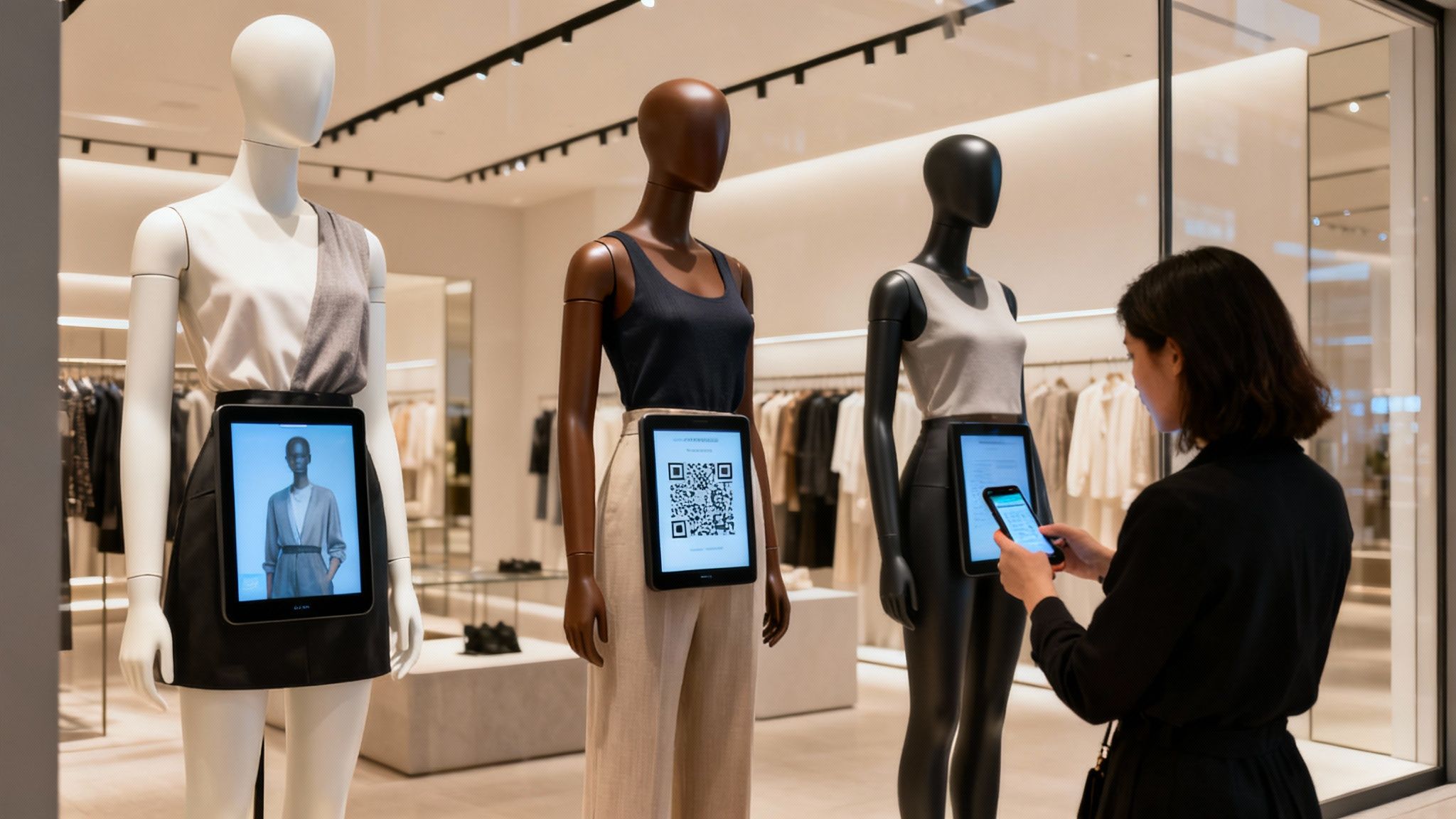
This idea perfectly captures the evolution from a simple try-on feature to the creation of an entire virtual photo shoot experience.
The Rise of the Virtual Photo Shoot
The next evolution of this technology is about placing creative power directly into the hands of the user. It moves beyond fit verification to enable individuals to become their own stylists, photographers, and art directors.
As Trevor Sumner, CEO of Perch, observes, "The next generation of shoppers are creators. They want to co-create with brands and share their experience... AR shopping is a form of entertainment and content creation."
Platforms like DreamShootAI's Virtual Try-on are at the vanguard of this movement. By uploading a few photos, users can generate incredibly realistic images of themselves wearing different outfits in diverse settings. It’s less a dressing room and more a personal AI-powered photo studio.
You can see for yourself how to try on clothes online with AI and experience it firsthand. This approach cedes complete creative control, transforming a practical fitting tool into something genuinely fun and imaginative.
Where Virtual Fit Is Headed (And the Hurdles Along the Way)
While the advantages are clear, the path to a perfect virtual dressing room is not without its challenges. For all the incredible progress, it is essential to acknowledge the hurdles that developers and retailers are actively addressing.
Achieving perfect fit fidelity remains the holy grail. Simulating the distinct drape of stiff denim versus flowy silk across millions of unique body shapes presents a formidable technical puzzle. Furthermore, consumers have valid privacy concerns regarding their photos and body measurements. Reputable companies understand this and are investing heavily in robust security protocols to build and maintain user trust.
The Next Chapter in Digital Fashion
Despite these obstacles, the industry is advancing at an exponential rate. The virtual fitting room market, focused on achieving realistic sizing, is undergoing explosive growth. According to a market report by Grand View Research, the market size, valued at USD 4.03 billion in 2022, is projected to reach USD 14.88 billion by 2030. That isn't just growth; it's a massive vote of confidence in the technology's trajectory. You can dig into the numbers and learn more about virtual fitting room market trends to see for yourself.
This boom is fueled by a vision that extends far beyond simple fit checks. The future is about creating a digital experience that is almost tangible.
"We are moving from simply seeing the clothes to truly experiencing them digitally."
— Jonathan Chippindale, CEO of Holition
This sentiment perfectly captures the industry's momentum. Imagine a future with:
- Haptic Feedback: Haptic suits or gloves could allow you to "feel" the texture of fabrics through your screen, distinguishing between soft cashmere and rugged leather from home.
- Metaverse Integration: Shopping could evolve into a social event in the metaverse, where avatars of you and your friends browse digital boutiques together from anywhere in the world.
- Hyper-Personalized Styling: AI stylists will not just recommend what fits; they will learn your unique style, curating entire outfits based on your purchase history and upcoming calendar events.
As this technology becomes more adept at handling complex garments, it’s insightful to recall the painstaking manual labor of traditional dressmaking. Reviewing the extensive guide to adjustable dressmaking forms provides a deeper appreciation for the foundation upon which this new technology is built. It’s clear we’re on a path toward a more immersive, accurate, and trustworthy way to shop online.
Ready to Try on the Future? Here's How to Get Started
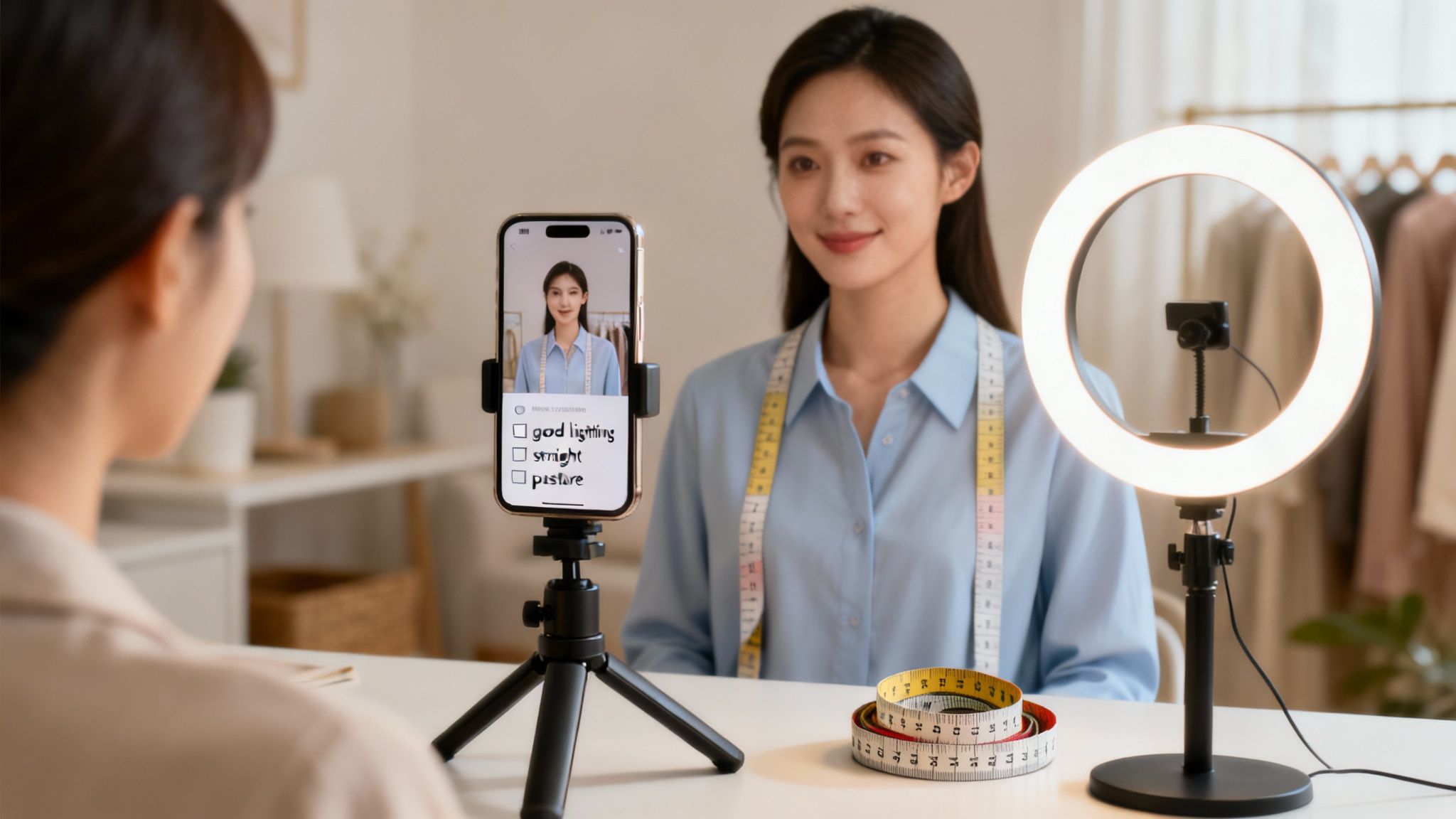
Whether you’re a consumer eager to try on your first virtual outfit or a retailer considering integrating this technology, getting started is more accessible than you might think. For both parties, success hinges on a few key practices to ensure the experience is accurate, engaging, and genuinely useful.
For shoppers, the fidelity of a virtual try-on begins with the quality of the uploaded photos. Much like a physical mirror, good lighting is paramount.
Tips for Shoppers
To achieve results that are a true representation of you, follow these simple guidelines:
- Light It Up: Position yourself in a space with bright, even illumination. Facing a window is ideal; avoid harsh overhead lighting that can create distorting shadows which may confuse the AI.
- Keep It Clean: A plain, uncluttered background is essential. It enables the technology to focus exclusively on your form, not the objects behind you, resulting in a cleaner and more accurate garment overlay.
- Strike a Pose (A Simple One): A full-body shot, from head to toe, is required. Stand straight, face the camera, and maintain a natural, relaxed posture. This provides the software with the clear data points needed to map the clothing to your figure correctly.
These steps provide the AI with the best possible data, which translates into a more believable and useful preview of how an item will actually look and fit.
A Guide for Retailers
For businesses, implementing a virtual dressing room is a strategic decision, not just a feature addition. The primary objective is to select a solution that not only performs with high accuracy but also integrates seamlessly with your existing e-commerce platform, whether it's Shopify, Magento, or a custom build.
As Michał Szehidewicz, a Senior Retail Consultant at Netguru, explains, "We aimed to create a project that would best address their business goals. We designed the user path of the virtual try-on tool to allow users to see how clothes would look on their specific body type."
When evaluating technology partners, prioritize the accuracy of their AI, the ease of integration, and the robustness of their data security protocols. Crucially, educate your customers about this new functionality. Develop engaging tutorials and marketing campaigns that showcase the ease and utility of trying on clothes from their couch.
If you're looking for an engaging way to introduce this concept, platforms that offer a creative AI clothes changer can be a fantastic entry point for your customers.
Frequently Asked Questions
As virtual dressing rooms become more integrated into our online shopping experiences, questions naturally arise. Let's address some of the most common inquiries regarding this technology's efficacy, security, and functionality.
How Accurate Are Virtual Dressing Rooms?
Accuracy varies significantly depending on the underlying technology. Simpler AR overlays, which superimpose a 2D image of a garment onto your camera feed, are effective for assessing style and color. However, they provide limited insight into the actual fit.
Conversely, advanced systems utilizing AI and 3D body scanning can achieve a remarkable degree of precision. These platforms can generate size recommendations that are often more accurate than generic size charts, bringing you much closer to the "perfect fit" experience of a physical fitting room.
Is My Data Safe When Using a Virtual Try-On?
This is a critical concern, and one that reputable virtual try-on companies take with the utmost seriousness. Leading providers employ robust security measures to protect your information.
- Data Encryption: Your images and measurements are secured using strong encryption, making them inaccessible to unauthorized parties.
- Anonymization: Data is typically processed in a way that removes personally identifiable information, disassociating it from you as an individual.
- Privacy Compliance: Companies are legally obligated to adhere to stringent data privacy regulations like GDPR and CCPA, ensuring responsible handling of your information.
As a best practice, always review a platform's privacy policy before uploading any photos. For businesses, selecting a technology partner with an uncompromising commitment to security is non-negotiable for maintaining customer trust.
What Is the Difference Between AR Try-On and a 3D Virtual Fitting Room?
This is an excellent question, as the terms are often used interchangeably despite representing different technological approaches.
AR Try-On is generally the more basic implementation. It typically overlays a flat, 2D image of an outfit onto your live video or a static photograph. It is fast, accessible, and ideal for a quick visualization of style and color.
A 3D Virtual Fitting Room represents a more sophisticated level of technology. It creates a digital 3D model of you—a personalized avatar—and then simulates how a 3D model of the garment would actually hang, stretch, and drape on your specific body. This provides a much richer, more nuanced understanding of not just the look, but the true size and fit.
Ready to create your own stunning, AI-powered photoshoots? With DreamShootAI, you can generate professional-quality images in countless styles and settings, from wedding portraits to dynamic social media content. Start your AI photo studio experience today at dreamshootai.com.
Written by Jocelyn Grey for the DreamShootAI blog.
Spotted something out of date? Tell us at [email protected] and we'll fix it.